
 Available in US
Why Hockey Betting Is the UK's Smartest Undervalued Market
Three years ago, I placed a bet on the Sheffield Steelers at 3.40 to beat the Belfast Giants in an EIHL regular-season fixture. The line was wrong — I knew it, the data confirmed it, and nobody else in the market cared enough to move it. That single moment crystallised something I had been seeing in my models for years: hockey betting in the UK is wide open, and the punters who treat it seriously have a structural advantage over the bookmakers who treat it as an afterthought.
The UK online gambling market hit USD 9.0 billion in 2025 and is forecast to climb to USD 13.2 billion by 2034. Football dominates the conversation, the marketing spend, and the odds compilers' attention. That dominance creates a blind spot. Ice hockey — the number-one attended indoor professional sport in Britain and the third-largest winter spectator sport after football and rugby union — gets a fraction of the analytical effort from both bookmakers and bettors. For anyone willing to do the work, that gap between attention and opportunity is where profit lives.

I have spent a decade modelling NHL and EIHL outcomes, evaluating odds across UK-licensed operators, and identifying value in markets that most punters scroll past on their way to the Premier League. This guide is the distillation of that experience. It covers how hockey betting works mechanically, what makes the major markets tick, why the NHL's financial trajectory matters to your bet slip, and how to build an edge rather than chase tips. Whether you are placing your first hockey wager or refining an existing approach, every section is built on data and practical experience — not recycled bookmaker copy.
Hockey betting rewards patience, statistical literacy, and a willingness to look where others do not. The sport's structure — fast, low-scoring, heavily influenced by goaltending and schedule density — creates pricing inefficiencies that persist because the market is thinner than football or tennis. If you have ever felt like the football markets are too efficient to beat consistently, hockey is the sport that should be next on your list.

What Every UK Hockey Punter Needs to Know Before Kick-Off
- Hockey is the UK's most underpriced betting sport — thinner markets and less compiler attention create persistent value that football and tennis rarely offer.
- NHL underdogs won outright 39.1% of the time in 2024-25 and covered the puck line at roughly 60%, making the spread a consistently exploitable market.
- Home underdogs posted a 63.9% cover rate against the spread — the single strongest angle backed by recent data.
- The NHL is a USD 7.5–8 billion revenue league with record attendance and expanding media deals; growth means more markets, deeper liquidity, and sharper lines ahead — early movers benefit most.
- UKGC-licensed operators must meet strict responsible gambling standards; choosing a regulated bookmaker with competitive hockey odds is the non-negotiable first step.
How Hockey Betting Works: From Puck Drop to Payout
The first time I walked a friend through a hockey bet, he looked at the screen and said, "Why are there three columns of numbers?" He had bet on football for years and never once needed to think about whether overtime counted. That confusion is common — and it costs new hockey bettors money before they even understand the markets. So let me strip it back to the fundamentals.
Hockey betting follows the same core mechanics as any other sport on a UK sportsbook: you pick an outcome, place a stake, and get paid if you are right. The difference is in the details. An NHL game consists of three 20-minute periods of regulation time, and if the score is tied after 60 minutes, the game goes to a five-minute overtime period followed by a shootout if necessary. This overtime structure is critical because some markets settle after regulation only, while others include overtime and the shootout. Misunderstanding which rules apply to your bet is the single most expensive beginner mistake in hockey wagering.
Regulation Time vs. Full Time
When a UK bookmaker lists a "three-way" or "60-minute" market, the bet settles at the end of regulation — overtime does not count. When you see a two-way moneyline (match winner), the bet includes overtime and the shootout. Always check the market rules on your bet slip before confirming. This distinction does not exist in football betting, which is why it catches crossover punters off guard.

Eight percent of UK adults bet on sports online or via an app, and the vast majority of that activity is concentrated on football and horse racing. Hockey sits in a quieter corner of the sportsbook, which means the odds compilers often set lines with less granular data and fewer market participants to correct errors. For the bettor willing to learn the sport's structure, this creates a tangible edge. Jason Jazayeri, the NHL's VP of Business Development, captured the momentum well when he described the league as "younger, faster and more exciting than ever," delivering what he called a "tremendous opportunity for fan engagement." That engagement is translating directly into betting market growth — more liquidity, more prop markets, and more in-play options appearing on UK platforms every season.
The practical flow of a hockey bet works like this: you log into a UKGC-licensed sportsbook, navigate to ice hockey (usually nested under "Winter Sports" or its own tab), select a league — the NHL is the most widely covered, followed by the EIHL, SHL, KHL, and European leagues — and choose a market. Markets range from simple match winners to complex player props. You add the selection to your bet slip, enter your stake, confirm the potential return, and place the bet. For a detailed walkthrough of every step, from account setup to reading the bet slip, see the step-by-step guide for beginners.
A Simple Hockey Bet: Match Winner
Suppose an NHL regular-season game between Team A and Team B is listed at the following decimal odds: Team A 2.10, Team B 1.80. You believe Team A offers value based on your analysis of goaltender matchups and recent form.
You place a GBP 10 stake on Team A at 2.10.
If Team A wins (in regulation, overtime, or shootout — this is a two-way moneyline), your return is: GBP 10 x 2.10 = GBP 21.00, for a net profit of GBP 11.00.
If Team B wins, you lose the GBP 10 stake.
The implied probability of Team A winning at 2.10 is: 1 / 2.10 = 47.6%. If your model rates Team A's true win probability at 52% or above, this bet has positive expected value.

That expected-value calculation is the foundation of everything that follows in this guide. The mechanics of placing the bet are straightforward — the skill is in identifying when the bookmaker's price underestimates the true probability of an outcome. Hockey's thinner market and the sport's inherent volatility (a hot goaltender can single-handedly swing a game) make those mispriced opportunities more frequent than in football, where millions of pounds of market activity correct lines within minutes of opening.
The Main Hockey Betting Markets at a Glance
I remember the exact moment I realised puck line betting was going to become my bread and butter. It was a Tuesday night slate, four NHL games, and I noticed the same pattern across every match: underdogs were priced attractively on the spread but ignored by the public loading up on favourites. The data confirmed what I was seeing — and it has not stopped confirming it since.
Hockey betting revolves around three core markets. The moneyline (match winner) is the simplest: pick the team that wins the game, overtime and shootout included. The puck line is hockey's version of the spread, almost always set at -1.5 for the favourite and +1.5 for the underdog. The over/under (totals) asks you to predict whether the combined goals in a game will finish above or below a set number, typically between 5.0 and 6.5 depending on the matchup.
| Market | What You Predict | Overtime Included? | Typical Odds Range |
|---|---|---|---|
| Moneyline | Which team wins | Yes (OT + shootout) | 1.40–3.50 |
| Puck Line (-1.5 / +1.5) | Win margin relative to spread | Yes | 1.50–2.80 |
| Over/Under (Totals) | Combined goals above or below line | Yes (most operators) | 1.85–1.95 |
The puck line deserves special attention from UK punters because the numbers tilt heavily in one direction. During the 2024-25 NHL season, underdogs won outright at a 39.1% rate — only baseball produced more upsets among the four major North American leagues. On the puck line, underdogs covered the +1.5 spread at roughly 60%. That means if you had blindly backed every underdog on the puck line all season, you would have been right six times out of ten. Blind betting is never a strategy, but those baseline numbers tell you where the structural inefficiency sits.
Puck Line in Practice
Team A is the favourite at -1.5 (odds 2.30). Team B is the underdog at +1.5 (odds 1.65). If you back Team B at +1.5 and they lose 3-2, your bet still wins because the 1.5-goal cushion covers the one-goal deficit. Team B only loses the puck line bet if they lose by two or more goals.
Beyond these three pillars, UK sportsbooks offer period betting (first-period winner, period totals), player props (anytime goalscorer, shots on goal, points), and futures (Stanley Cup winner, conference champion, division winner). Each carries different margins and liquidity levels. For a deeper breakdown of how odds are structured across these markets, the full hockey odds guide walks through the maths and format conversions in detail.

The NHL Betting Landscape: Revenue, Growth, and Why It Matters
Most betting guides treat the NHL as a static backdrop — here are the teams, here are the markets, go place your bets. That approach ignores the single most important context for any serious hockey bettor: the league is in the middle of an unprecedented financial expansion, and that expansion directly shapes the betting landscape you are operating in.
Projected 2025-26 Revenue
USD 7.5–8.0 billion
Average Franchise Value
USD 2.2 billion (up 15% YoY)
2024-25 Season Attendance
23+ million fans (record)
Salary Cap 2025-26
USD 95.5 million
Sponsorship Revenue
USD 1.53 billion (2024-25)
U.S. Media Rights Deal
USD 4.5 billion over 7 years

Those numbers are not abstract. NHL Commissioner Gary Bettman declared at the 2026 State of the League address that growth is happening across every revenue stream and every distribution platform simultaneously, with even stronger numbers expected once the new Canadian media deal takes effect. That Canadian deal with Rogers is worth CAD 11 billion (approximately USD 7.7 billion) through the 2037-38 season. When a league is growing this aggressively, the downstream effects reach your bet slip in three concrete ways.
First, revenue growth means more media coverage, which means more eyeballs, which means more betting volume. Higher volume improves market liquidity — the odds become sharper, the spreads between operators narrow, and the prop markets deepen. The Western Conference Final 2026 averaged 2.2 million viewers over four games on ESPN, a 44% year-over-year increase. That kind of viewership growth pulls casual bettors into the market, and casual money is the raw material that creates value for analytical bettors.
Second, the salary cap trajectory matters for season-long handicapping. The cap is set at USD 95.5 million for 2025-26, estimated to rise to USD 104 million and then USD 113.5 million over the following two years — a 25% spike across three seasons. Teams that are cap-constrained today will have significantly more flexibility to add talent. Teams that have front-loaded contracts against the current cap may find themselves with depth advantages as the ceiling rises. If you are betting futures or making early-season assessments, ignoring the cap landscape is leaving edge on the table.
Third, the NHL's integrity infrastructure gives bettors confidence that the games themselves are clean. The league partnered with prediction market platforms Kalshi and Polymarket in October 2025 — the first major U.S. pro sports league to do so — and signed a memorandum of understanding with the CFTC in May 2026 for two-way information sharing. Bettman has repeatedly stated that he monitors every minute of every game in terms of play and line movement. None of this guarantees a corruption-free sport, but the structural safeguards are more robust than in many leagues that attract far more betting attention.
Record attendance, record revenue, expanding media deals, rising salary caps, and a league-level commitment to betting integrity. That is the environment you are betting into. Understanding it does not tell you which team to back on Tuesday night, but it shapes the market conditions that determine whether your analytical edge will be rewarded or eroded over time.
EIHL Betting: The UK's Home Ice Opportunity
I attended a Belfast Giants home game in 2023 expecting a half-empty arena and lukewarm atmosphere. What I found was 7,000 fans making more noise than a mid-table Premier League crowd. That experience changed how I approached domestic hockey betting entirely — the EIHL is not a minor curiosity; it is a genuine sporting product with a passionate fanbase and, crucially, a betting market so thin that edges persist for weeks at a time.
The Elite Ice Hockey League is the top-tier professional ice hockey competition in the United Kingdom, featuring teams from England, Scotland, Wales, and Northern Ireland. The 2025-26 season smashed records for the fourth consecutive year, drawing 1,321,128 fans across 270 matches — an average of 3,863 per game. Mark Brooks, the EIHL's Head of Commercial Operations, called it "a significant milestone for the league and a real credit to our teams and fans," pointing to the outstanding atmosphere and the momentum the sport is building. Those are not the words of someone managing a niche hobby league; that is a competition on an upward trajectory with real commercial heft behind it.
Sheffield Steelers averaged 8,122 fans per game in 2025-26, including a league-record 9,512 for Boxing Day 2025. That single-game figure would fill most League Two football grounds in England.
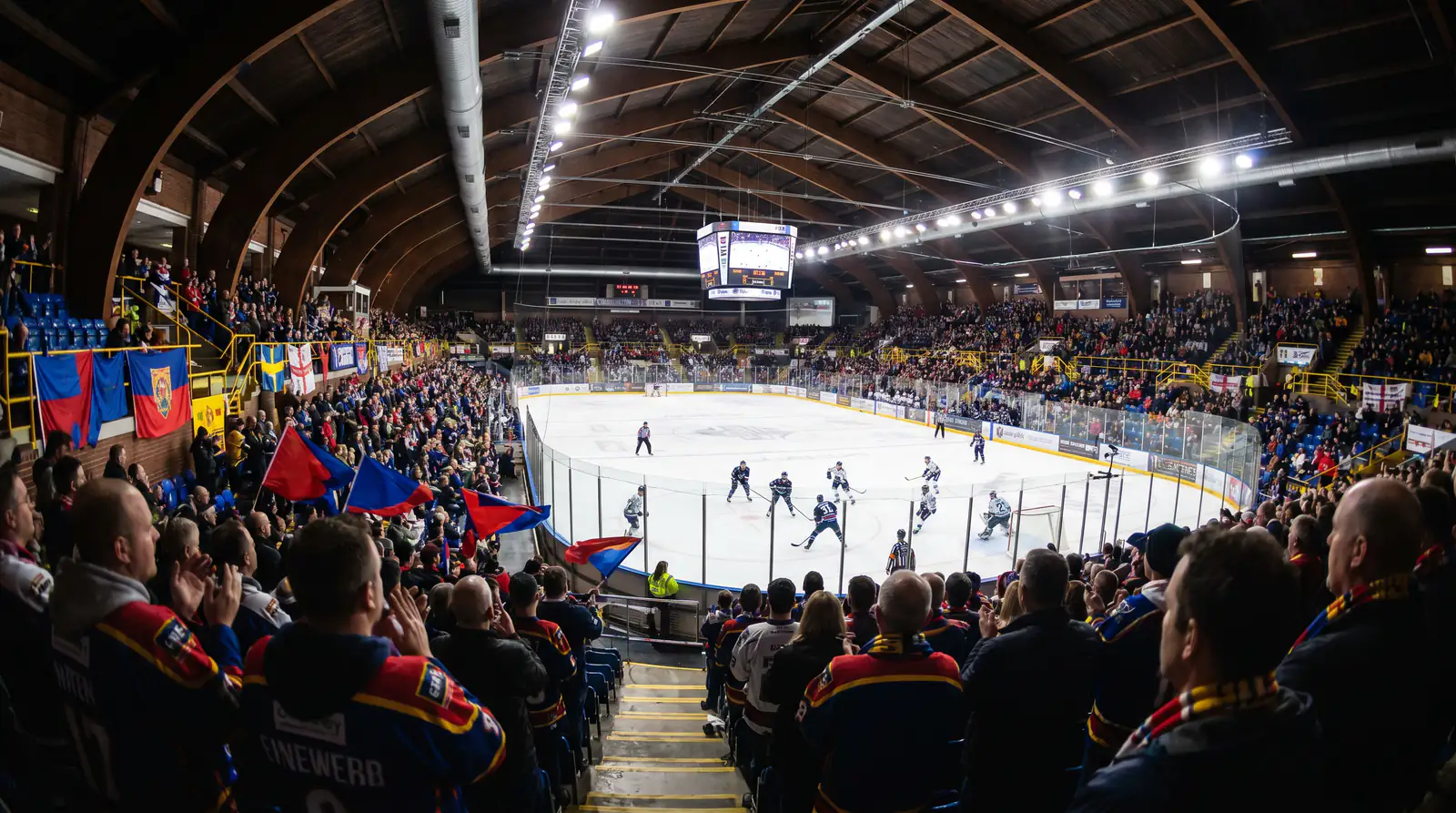
For UK bettors, the EIHL presents an opportunity that the NHL cannot replicate: local knowledge. If you follow the Nottingham Panthers or the Cardiff Devils, you know about roster changes, injury situations, and team form weeks before the bookmaker's odds compiler catches up. EIHL markets are listed by fewer operators, the odds are set with less analytical depth, and the betting volume is low enough that even modest knowledge advantages translate into mispriced lines. I have found value on EIHL matches simply by checking team social media accounts for lineup announcements an hour before game time — information the sportsbook was not reflecting in the price.
Ice hockey holds the distinction of being the number-one attended indoor professional sport in the UK and the third-largest winter spectator sport after football and rugby union. That status has not yet translated into proportional betting market depth, which is precisely the gap that informed bettors can exploit. The EIHL regular season runs from September to April, with playoffs following, giving UK punters roughly eight months of domestic hockey to bet on alongside the NHL season.
The practical challenge with EIHL betting is market availability. Not every UK-licensed bookmaker lists EIHL fixtures, and those that do may only offer match-winner and totals markets. Prop bets and in-play markets are rare. For a full breakdown of which operators cover the EIHL and how to approach domestic hockey wagering, the dedicated EIHL betting guide covers every angle from market access to league-specific handicapping.
Choosing a Hockey Bookmaker in the UK
I wasted the first two years of my hockey betting career using a single operator. The margins I was giving up through uncompetitive odds wiped out edge that my models were generating. The day I opened accounts with three additional UKGC-licensed bookmakers and started line shopping, my long-term ROI improved by over two percentage points — without changing a single element of my selection process.
Sports betting is the largest segment in UK online gambling, accounting for a 57.1% revenue share in 2025. That dominance means operators compete fiercely for football and horse racing bettors. Hockey, by contrast, is a lower-priority sport for most UK sportsbooks. The practical consequence: odds quality, market range, and in-play availability vary enormously between operators for ice hockey. Two bookmakers listing the same NHL game can differ by 10–15% in implied probability on the moneyline — a spread you would almost never see on a Premier League match.
Choosing the right bookmaker for hockey betting is not about finding "the best" operator — it is about building a portfolio of accounts that gives you access to the best price on any given market. The criteria that matter for hockey are different from the criteria that matter for football, and most operator comparison guides ignore this entirely.
| Criterion | Why It Matters for Hockey | What to Check |
|---|---|---|
| League coverage | Not all operators list EIHL, SHL, KHL, or Liiga | Search for specific leagues before depositing |
| Market depth | Some offer only match-winner; others include period bets, player props, futures | Open a test fixture and count available markets |
| In-play availability | NHL games run 22:00–05:00 UK time; not all operators staff live hockey odds overnight | Check a live NHL game at midnight for active markets |
| Odds competitiveness | Hockey margins are wider than football; shopping saves real money | Compare the same moneyline across 3+ operators before every bet |
| Cash-out and partial cash-out | Useful for managing risk on parlays and in-play positions | Verify cash-out is offered on hockey markets, not just football |
Every operator you use for hockey betting must hold a valid UK Gambling Commission licence. This is non-negotiable. A UKGC licence ensures that the operator meets standards for fair play, customer fund segregation, dispute resolution, and responsible gambling tools. The illegal gambling market is growing — forecasts suggest stakes with unlicensed operators could nearly double by 2028 — and the risks of using unregulated platforms extend beyond legality to the practical reality that you have no recourse if a payout is denied or an account is closed without explanation.
Before You Open a Hockey Betting Account
- Confirm the operator holds a current UKGC licence (check the Gambling Commission register directly)
- Verify that NHL and EIHL fixtures are listed with pre-match and in-play markets
- Compare moneyline odds on the same game across at least three operators
- Check whether player props and period betting are available for NHL games
- Test the cash-out feature on a hockey market before relying on it
- Review the operator's responsible gambling tools: deposit limits, session timers, self-exclusion

For a detailed breakdown of what to look for in a hockey-focused sportsbook — including how to evaluate odds margins and market depth across different leagues — the guide to hockey betting sites in the UK provides a structured framework you can apply to any operator.
Reading and Comparing Hockey Odds
A friend once showed me his bet slip with a confused expression. He had backed a team at "plus one fifty" and could not understand why his GBP 20 stake was returning less than he expected. The problem was simple: he was reading American odds on a UK platform that had defaulted to the wrong format. It took two minutes to fix in the settings. It would have taken two seconds if he had understood what the numbers meant.
UK bookmakers display hockey odds in three formats: decimal, fractional, and American. Decimal odds are the standard on most UK platforms and the easiest to work with. The number you see is the total return per pound staked, including your original stake. Fractional odds — the traditional British format — express profit relative to stake. American odds use a plus/minus system anchored to 100. You will encounter all three when reading hockey content, checking odds comparison sites, or following North American tipsters, so converting between them is a practical skill, not an academic exercise.
The Same Price in Three Formats
| Format | Price | GBP 10 Stake Returns | Implied Probability |
|---|---|---|---|
| Decimal | 2.50 | GBP 25.00 (profit: GBP 15.00) | 40.0% |
| Fractional | 3/2 | GBP 25.00 (profit: GBP 15.00) | 40.0% |
| American | +150 | GBP 25.00 (profit: GBP 15.00) | 40.0% |

The conversions are mechanical. To go from decimal to implied probability, divide 1 by the decimal odds: 1 / 2.50 = 0.40, or 40%. To go from fractional to decimal, divide the first number by the second and add 1: (3 / 2) + 1 = 2.50. For American odds, a positive number tells you the profit on a 100-unit stake (+150 means 150 profit on 100 staked), while a negative number tells you how much you need to stake to profit 100 (-150 means you stake 150 to profit 100).
What matters more than the conversion maths is understanding what implied probability reveals about the bookmaker's view of a game. If a team is listed at 1.80 (decimal), the bookmaker's implied probability is 55.6%. But the combined implied probabilities of all outcomes in a market always exceed 100% — the excess is the bookmaker's margin (the overround or vig). On a typical NHL moneyline, the overround sits between 4% and 8%. On puck lines, it can be slightly tighter. On player props, it balloons to 10% or more. Knowing where the margin lives helps you identify which markets offer the best value and which are structured to extract the most from casual bettors.

The practical habit I recommend to every hockey bettor: set your default odds format to decimal across all platforms, and convert every line to implied probability before placing a bet. If your assessed probability of an outcome is higher than the bookmaker's implied probability (after accounting for the overround), you have a value bet. If it is lower, the bet is not worth taking regardless of how "certain" the outcome feels. This discipline separates recreational punters from bettors who sustain long-term profitability.
One subtlety specific to hockey: odds move less aggressively than in football because the betting volume is lower. A sharp line move on an NHL game 30 minutes before puck drop almost always signals goaltender news or a significant injury report. If you see a moneyline shift by 10 or more cents (in decimal terms, a move from 2.10 to 2.00 or beyond), check the team's official channels before fading the move. In my experience, late line movement in hockey is more informative and less noise-driven than in higher-volume sports.
Strategy Foundations: Where the Edge Lives
A year into my hockey betting career, I tracked every bet I had placed and found something uncomfortable: my win rate was 54%, but I was barely breaking even. The problem was not selection quality — it was staking, discipline, and a failure to systematically target the spots where the bookmaker's model was weakest. Strategy in hockey betting is not about picking more winners. It is about identifying the specific conditions under which the odds consistently undervalue an outcome, and then having the process to exploit that gap repeatedly.
The single most powerful data point I lean on is this: home underdogs posted an against-the-spread record of 329-186 in the 2024-25 NHL season, covering the puck line at a 63.9% rate. That is not a one-season anomaly. Home-ice advantage in hockey is real — last change in faceoffs, crowd energy, no travel fatigue — but the betting market routinely underprices it when the home team is not the favourite. The public gravitates toward road favourites, especially big-name franchises, and that weight of money pushes the underdog's price to a level that overcompensates for the actual risk.
The Home Underdog Edge Is Structural, Not Seasonal
Home underdogs do not cover at 63.9% because of luck. They cover because the market systematically overweights the perceived quality gap between the two teams and underweights the tangible advantages of playing at home in a fast, physical sport. When the public sees a top-four team travelling to play a bottom-ten team, they assume the favourite will dominate. The scoreline disagrees more often than not.

Building a strategy around this insight requires more than just backing every home dog. You need filters. Is the home team on the second night of a back-to-back, which negates the rest advantage? Is the starting goaltender confirmed, or are you betting on a backup who drags the true probability down? Has the line moved toward the favourite since opening, suggesting sharp money disagrees with the public? Each filter sharpens the edge. Without filters, you are betting on a trend. With them, you are betting on a model.
Beyond the home underdog angle, the core strategic principles for hockey betting break down into process habits. These are the practices I have refined over a decade of tracking results, and they separate bettors who sustain profitability from those who run hot for a month and give it all back.
Do
- Track every bet in a spreadsheet with date, league, market, odds, stake, and result — review monthly
- Confirm the starting goaltender before placing any pre-match NHL bet
- Compare odds across at least three operators and take the best available price
- Focus on specific leagues and markets where your knowledge exceeds the bookmaker's model
- Set a fixed staking plan (flat stakes or percentage-of-bankroll) and follow it without exception
Don't
- Chase losses by doubling stakes after a losing run — variance in hockey is high and streaks are normal
- Bet on every game on the slate; selectivity is the primary driver of long-term ROI
- Ignore line movement — a significant shift before puck drop carries more signal in hockey than in football
- Use accumulator bets as your primary strategy; the compounding margins destroy edge over time
- Rely on tipster services that do not publish verifiable, long-term track records with flat stakes
Strategy is not a destination — it is a process of continuous refinement. The bettors who profit from hockey over years, not weeks, are the ones who treat it as a discipline: data in, model out, bet placed, result recorded, model updated. For a deep dive into specific tactical approaches — from value identification frameworks to closing line value tracking — the data-driven hockey betting strategies guide covers each methodology in full.
Edge without discipline is just entertainment with extra steps. The next section addresses the framework that keeps the entire operation sustainable.
Staying in Control: Responsible Hockey Betting
I will be direct about something most betting guides bury in a footnote: I have had months where I lost money. Extended losing runs that tested my confidence in models I had spent hundreds of hours building. The difference between a sustainable bettor and someone who spirals is not skill — it is structure. Responsible betting is not a compliance checkbox; it is the operational framework that keeps you in the game long enough for your edge to compound.
The UK's regulated betting industry has made measurable progress on player protection. During Safer Gambling Week 2025, 281,000 deposit limits were set — a 41% increase year-over-year — and 10.95 million safer gambling messages were sent to customers, a 75% rise. The Betting and Gaming Council described the initiative as further evidence of the regulated industry's determination to keep raising standards. Those are not empty gestures; deposit limits are one of the most effective tools available for keeping betting within recreational boundaries.
Tools Every Hockey Bettor Should Activate
Every UKGC-licensed operator is required to offer deposit limits (daily, weekly, monthly), session time reminders, cooling-off periods, and self-exclusion options. Activate a deposit limit before you place your first hockey bet. Set it at a level you can afford to lose entirely over a month without affecting your financial obligations. If that number is zero, do not bet. These tools exist specifically because even disciplined, analytical bettors can misjudge their risk tolerance during losing streaks.

The practical application for hockey bettors is straightforward. Define a bankroll — a fixed sum of money allocated exclusively to betting, separate from your living expenses. Set a stake size as a percentage of that bankroll (I use 1–2% per bet, which means a GBP 500 bankroll translates to GBP 5–10 per wager). Record every bet. Review your P&L monthly. If you hit a drawdown threshold — I set mine at 20% of the bankroll — stop betting for at least a week and review your process before returning. This is not conservative advice; it is the minimum viable framework for surviving the variance that hockey's low-scoring nature produces.
Betting should enhance your enjoyment of hockey, not replace it. If you find yourself placing bets to recover losses, watching games only because you have money on them, or increasing stakes during cold streaks, those are signals to step back and reassess. The UK offers resources through GamCare, the National Gambling Helpline, and GAMSTOP (the national self-exclusion scheme). Using them is not a sign of weakness — it is the same discipline that makes a good bettor: knowing when the numbers are not in your favour and acting accordingly.
Frequently Asked Questions About Hockey Betting
Puck Line — Hockey's equivalent of the point spread, almost always set at +/-1.5 goals. The favourite must win by two or more; the underdog can lose by one and still "cover."
Moneyline — A straight bet on which team wins the game, with no spread involved. In hockey, the two-way moneyline includes overtime and shootout results.
Over/Under (Totals) — A bet on whether the combined goals scored by both teams will finish above or below a line set by the bookmaker, typically between 5.0 and 6.5 for NHL games.
How does betting on hockey work in the UK?
Hockey betting works like any other sport at a UKGC-licensed sportsbook. You select a league (NHL, EIHL, or others), choose a market (moneyline, puck line, totals, props), set your stake, and confirm the bet. The key difference from football is overtime: some markets include overtime and the shootout (two-way moneyline), while three-way or "regulation time" markets settle after 60 minutes only. Always check the market rules on your bet slip before confirming.
What is a puck line bet and how is it different from a moneyline?
A moneyline bet simply picks the winner. A puck line bet adds a 1.5-goal spread: the favourite is listed at -1.5 (must win by two or more) and the underdog at +1.5 (can lose by one goal and the bet still wins). The puck line offers better odds on favourites and worse odds on underdogs compared to the moneyline, but the underdog's puck line has historically covered at a rate near 60% in the NHL, making it a strategically significant market.
Which UK bookmakers offer the best hockey betting markets?
Rather than naming a single "best" bookmaker, the most effective approach is to hold accounts with three or four UKGC-licensed operators and compare odds on each game. Hockey odds quality varies more between operators than football odds do, so line shopping is essential. Evaluate each operator on league coverage (NHL, EIHL, European leagues), market depth (props, period bets, futures), in-play availability, and the competitiveness of their moneyline margins.
Can I bet on the EIHL (Elite Ice Hockey League) in the UK?
Yes, several UKGC-licensed bookmakers list EIHL fixtures during the regular season (September to April) and the playoffs. Market availability is narrower than for the NHL — typically limited to match-winner and totals — but the thin market also means odds are less efficient, which creates opportunities for bettors with local knowledge of teams, rosters, and form.
What are the most profitable hockey betting strategies?
The most data-supported approach is targeting home underdogs on the puck line, where the cover rate exceeded 63% in the 2024-25 NHL season. Beyond that single angle, profitable strategies include confirming goaltender starts before betting, tracking closing line value to measure the accuracy of your selections over time, line shopping across multiple operators, and applying strict bankroll management with flat staking. No strategy guarantees profit, but these approaches give you a structural advantage over recreational bettors.
How do I read and convert hockey betting odds?
UK sportsbooks typically display decimal odds by default. To find the implied probability, divide 1 by the decimal odds (e.g., 1 / 2.00 = 50%). To convert fractional odds to decimal, divide the numerator by the denominator and add 1 (e.g., 5/4 becomes 2.25). For American odds, positive numbers show profit per 100-unit stake (+200 = 200 profit on 100 staked = 3.00 decimal), while negative numbers show how much to stake for 100 profit (-150 = stake 150 for 100 profit = 1.67 decimal). Set your platform to decimal and always convert to implied probability before betting.
Is live betting on hockey available at UK sportsbooks?
Yes, most major UK-licensed operators offer in-play betting on NHL games, though the schedule means live markets are typically active between 22:00 and 05:00 UK time. In-play markets include running moneylines, period totals, and next-goal markets. EIHL live betting is less widely available and may be limited to match-winner only. Odds update quickly in hockey due to the sport's pace, so fast execution and a reliable mobile connection are practical necessities for live wagering.
