
 Available in US
Content

Beyond the Scoreline: Team and Game Props in Hockey
There was a game two seasons ago — I cannot remember the exact matchup, but I remember the bet. I had no edge on the moneyline, no read on the total, but I noticed one team had scored first in 14 of their last 17 home games. The “team to score first” prop was sitting at even money, and I took it without thinking twice. That is the appeal of proposition bets in hockey: they let you isolate a specific tendency and bet on it directly, without needing to predict the final outcome. The global sports betting market hit $111.9 billion in 2025, and props are one of the fastest-growing segments driving that figure.
Game and team props in the NHL cover everything from which team scores first to the exact final score, the number of goals in a specific period, and whether a penalty will be called in the opening five minutes. These markets strip away the complexity of picking a winner and let you focus on granular patterns that the moneyline and totals markets cannot capture.
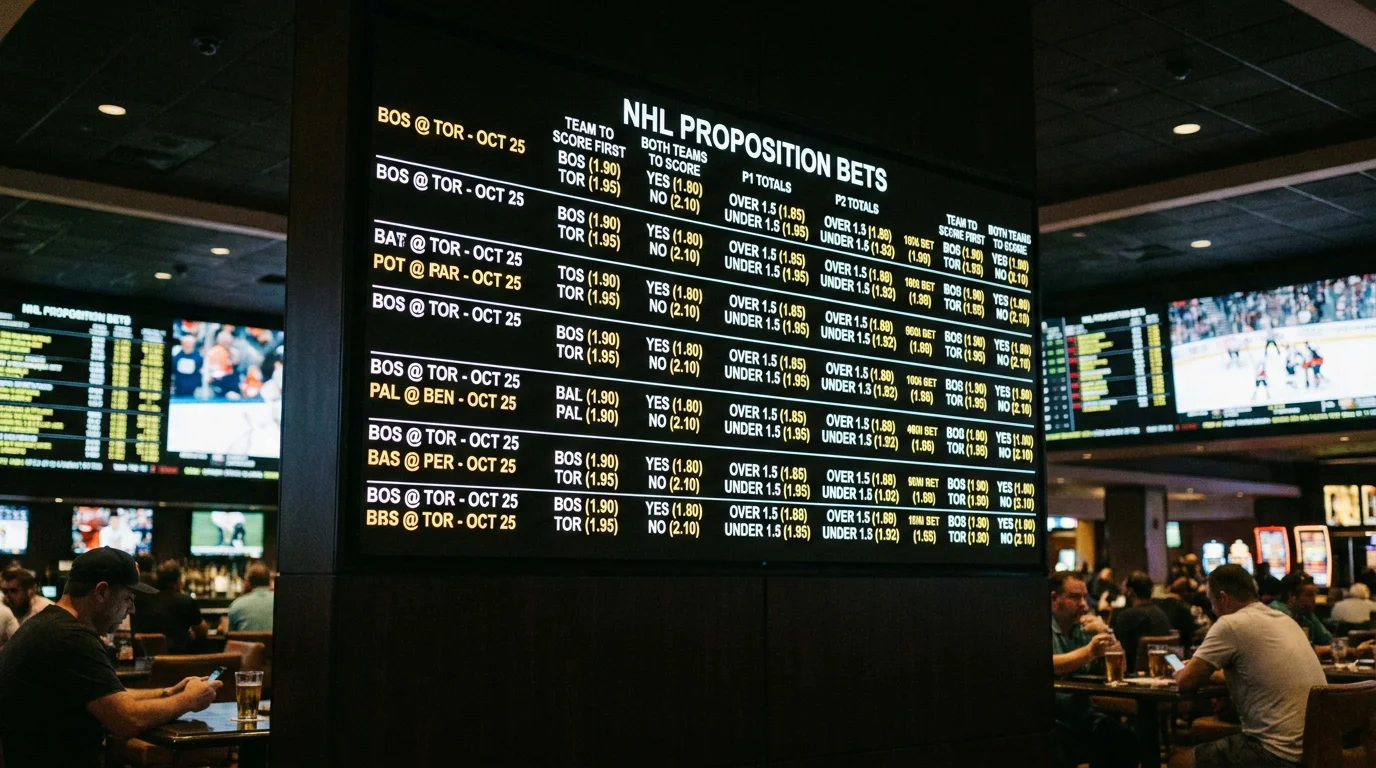
Most Common NHL Game Props at UK Bookmakers
I spent a week cataloguing every prop market available across four UK-facing bookmakers for a regular-season NHL Tuesday slate. The overlap was smaller than I expected. Some shops offered 40+ props per game while others topped out at 10. Knowing what is available — and where — is half the battle.
The most universally offered game props include team to score first, both teams to score, total goals odd or even, first scoring period, and whether the game will go to overtime. These are the bread-and-butter propositions that almost every licensed operator carries for NHL games. The odds on “both teams to score” in hockey are typically very short — around 1.15 to 1.25 — because shutouts are rare, occurring in only about 6-7% of NHL games. That makes it a low-return market on its own, but it becomes useful as a leg in accumulators.
Period betting is a natural extension of the game props category. You can bet on the result of the first period (home win, draw, away win) or on the total goals within a specific period. First-period unders have historically been a strong play because teams tend to feel each other out early, especially in nationally televised games where the pace is more cautious in the opening 20 minutes.
Exact score props are the highest-odds game prop you will find. Predicting a 3-2 final score might price at 8.00 to 12.00 depending on the matchup. These are fun bets with lottery-like returns, and I include one in my weekly slate purely for entertainment. Trying to build a serious strategy around exact score bets is a fool’s errand because the variance is simply too high.
Race to goals is another interesting market: which team reaches two goals first, or which team reaches three goals first. This prop rewards teams with fast starts, and it correlates with first-period dominance data. Teams that score first in the NHL go on to win about 67-70% of the time, so the “race to two goals” market carries an implied advantage for sides with strong starts.

Team Props: Power Play Goals, Penalty Minutes, and More
I have a soft spot for team-level props because they reward the kind of deep statistical research that most casual bettors skip entirely. Football holds roughly 35% of the global sports betting market by revenue, and hockey’s smaller profile means less sharp money flows into these niche team props. That inefficiency is real and exploitable.
The most valuable team prop, in my experience, is “team total goals.” This market sets a line for how many goals a specific team will score — usually 2.5 or 3.5 — and you bet over or under. It differs from the game total because it isolates one team’s offensive output. If you have a strong read on a goaltender matchup, the team total lets you express that view precisely. Backing the over on Team A’s goals when they face a backup goaltender is a cleaner bet than taking the game total over because it removes the variance introduced by the other team’s scoring.

Power play goals as a prop has grown in availability over the last two seasons. You can bet on whether a specific team will score a power play goal during the game, or on the total number of power play goals in the game. Teams with elite power play units — think conversion rates above 25% — and opponents who take frequent penalties create obvious spots for this market. The key data points are power play conversion rate and opponent penalty frequency per game, both of which are publicly available on NHL statistical sites.
Penalty minutes props are the wildcard. Some matchups between physical, rivalry-driven teams consistently produce higher penalty totals. Tracking penalty minutes per game by team pairing — not just by team in isolation — reveals patterns the bookmaker’s model might not fully capture. A team that averages 8 penalty minutes per game overall might average 12 when facing a specific divisional rival.

Spotting Value in Hockey Props
Every sharp bettor I respect has told me some version of the same thing: prop markets are the last frontier for finding genuine edges. The reason is structural. Bookmakers devote their best resources — sharpest compilers, deepest models — to the moneyline and totals. Props get less attention, less modelling precision, and more reliance on algorithmic formulas that do not fully account for situational factors.
My process for finding value in props starts with identifying what I know that the line does not reflect. If I know a team’s starting goaltender has a save percentage below .890 in his last five starts and the “both teams to score” line is set at the usual 1.20, that information might already be priced in. But if the “team to score first” prop does not adjust for the goaltender’s slow starts — and it often does not, because goal sequence props are less sensitive to goaltending models than totals are — there might be a gap.
Cross-referencing props with main markets is another technique. If the moneyline implies a 60% win probability for one team but the “team to score first” prop implies only a 50% probability for the same team, there is a disconnect. One of those markets is wrong. Historical data on how often the favourite scores first, filtered by home and away splits, helps you determine which market offers the better price.
One practical warning: prop bet limits at UK bookmakers are typically much lower than moneyline or totals limits. You might be able to stake hundreds on a moneyline but only tens on a niche prop. This limits the absolute profit potential but does not diminish the value — smaller stakes at higher ROI percentages still compound meaningfully over a season.

NHL Prop Bet Questions
Are NHL prop bets available at UK bookmakers?
Yes. Most major UK-licensed bookmakers offer NHL props for regular-season and playoff games. The range varies significantly between operators — some list 40+ props per game while others offer only basic options like team to score first and both teams to score. Availability for EIHL props is much more limited.
Which NHL game props have the lowest bookmaker margins?
The lowest-margin game props tend to be the most liquid markets: both teams to score, game total over/under, and team to score first. These attract enough volume that bookmakers keep margins competitive. Niche props like exact score, period-specific totals, and penalty minute markets typically carry wider margins due to lower betting volume.
