
 Available in US
Content

The Grand Salami Adds Up Every NHL Goal on the Slate
I discovered the grand salami by accident. I was scrolling through a bookmaker’s NHL section on a Tuesday night – six games on the card – and noticed a market I had never seen before: “Total Goals All Games, Over/Under 33.5.” It was one number that distilled an entire evening of hockey into a single bet. That simplicity hooked me immediately, and three seasons later the grand salami remains one of my favourite niche markets in all of sports betting.
The grand salami is an over/under bet on the total number of goals scored across all NHL games on a given day’s schedule. If there are six games, the line might sit at 33.5. If there are 12 games, it could be 67.5. The concept is identical to a standard totals bet on a single game, but the scope expands to the entire slate. This aggregation changes the analytical approach completely – you are no longer assessing one goaltending matchup or one team’s pace. You are reading the league-wide environment.

How the Grand Salami Line Is Set
When I first started betting the grand salami, I assumed the line was simply the sum of all individual game totals. It is not that clean. The bookmaker sets the grand salami using individual game totals as a foundation but adjusts for market-level factors that individual game totals do not capture.

NHL gate receipts were at 96% of arena capacity in the 2024-25 season, and that packed-arena energy creates a slight scoring uplift in home environments that accumulates across a multi-game slate. If eight of 12 games on a Thursday night are home games for teams with strong offensive records, the grand salami line gets pushed upward. The bookmaker also accounts for the day of the week – Saturday night slates tend to feature more marquee matchups with higher-profile goaltenders, which can suppress scoring relative to midweek slates where more backups are in net.
The line typically appears in the morning of the game day, and it moves based on goaltender confirmations and sharp money. Because the grand salami aggregates multiple games, a single goaltender announcement has a smaller proportional effect than it would on an individual game total. But when three or four games on the slate confirm backup goaltenders – something that happens frequently on back-to-back nights – the cumulative effect can move the grand salami line by a full goal or more.
Identifying Grand Salami Value: Schedule, Goaltenders, and Slate Size
My grand salami process starts with slate composition. A five-game slate behaves differently from a 13-game slate in terms of variance. Fewer games mean each individual game’s outcome has a bigger impact on the total, increasing volatility. Larger slates smooth out the variance, making the grand salami more predictable. I prefer betting grand salamis on slates of eight or more games because the law of large numbers starts working in your favour – outlier games get diluted by the majority.
NHL underdogs win 39.1% of the time outright, and the competitive balance that statistic implies means most games produce scores in the 4-6 combined goal range. Gary Bettman has stated that the NHL monitors every minute of every game in terms of play and betting line activity – that level of oversight underscores the integrity of a league where outcomes are genuinely uncertain and scoring is organic rather than manufactured. For grand salami purposes, this competitive parity means the per-game goal average is remarkably stable around 6.0-6.2, and deviations from that baseline are usually driven by identifiable factors.

The three factors I weigh most heavily are: confirmed goaltender quality across the slate, the number of back-to-back situations, and the time of season. Early-season slates (October-November) tend to produce slightly higher scoring as teams work out defensive systems. Mid-season slates (December-February) are the most stable. Late-season slates (March-April) can swing either way depending on how many teams are resting players for the playoffs.
A practical example: last season, a Thursday slate featured 10 games. Three of those games had confirmed backup goaltenders, two featured divisional rivalries with historically low-scoring tendencies, and the rest were standard matchups. The grand salami was set at 59.5. My model – which assigns an expected goal total to each game based on goaltending, pace, and schedule context – projected a slate total of 62.3. I took the over at 1.90 and the slate finished with 64 combined goals. That 2.8-goal edge between my projection and the line is unusually large; most nights the gap is one goal or less, and I pass on the bet when my projection falls within one goal of the posted line.

Connecting the grand salami to individual game analysis is where the edges compound. If you are already researching over/under totals for single games, you have most of the inputs needed to form a grand salami opinion. The additional step is aggregating those single-game assessments and comparing the sum to the posted line.
Finding Grand Salami Markets at UK Bookmakers
Availability is the grand salami’s biggest limitation for UK bettors. Not every bookmaker carries this market, and among those that do, it is often listed in a separate “NHL Specials” or “Daily Specials” section rather than under the individual game listings. I have found it consistently at two of the five bookmakers I use regularly, and it appears intermittently at a third.
If your preferred bookmaker does not offer the grand salami, you can replicate the bet by taking individual game totals across the slate – but this is not economically identical. Combining individual totals into an accumulator multiplies the margins across legs, whereas the grand salami is a single market with a single margin. The grand salami is almost always the more efficient bet when available.
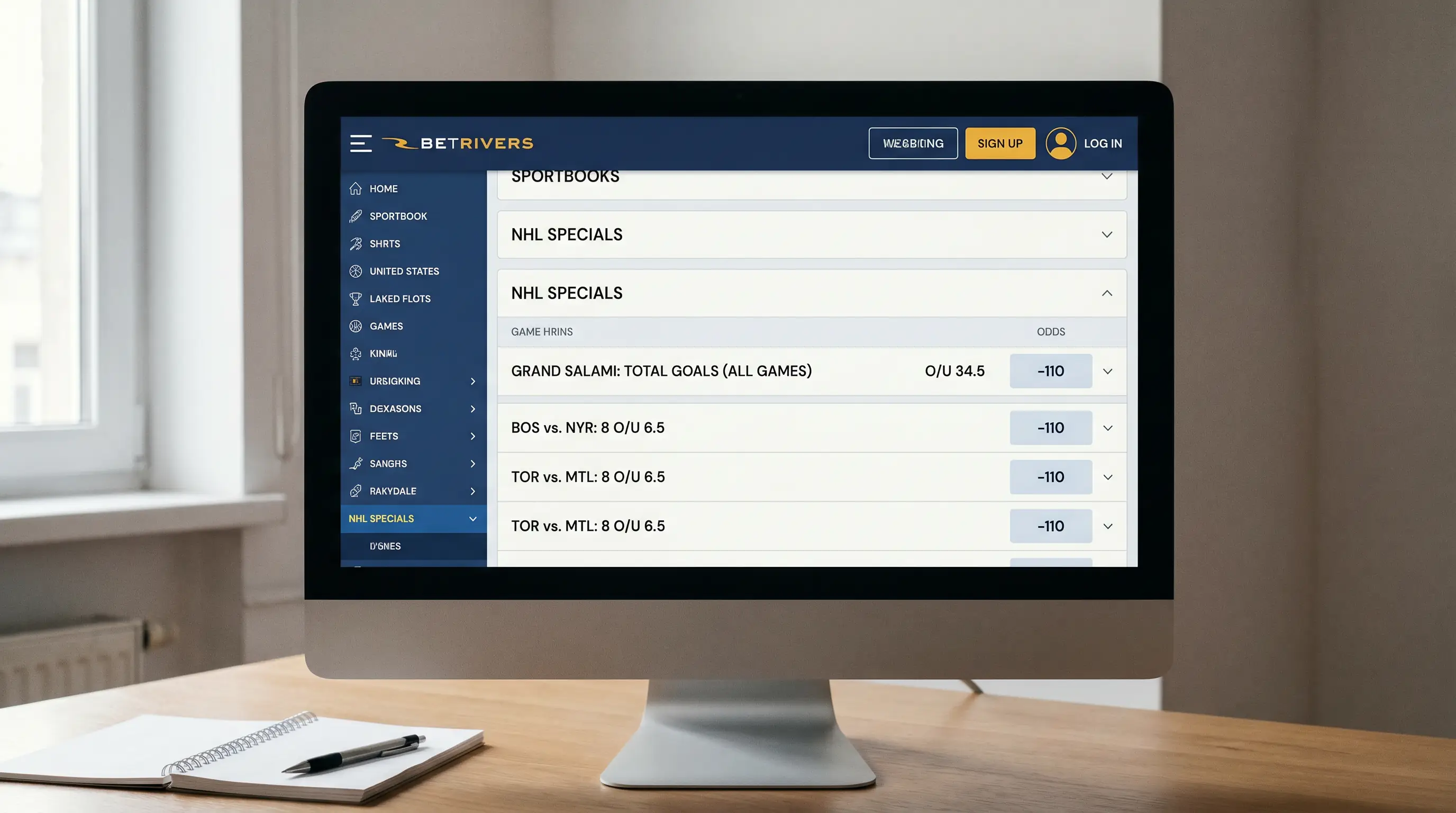
One tip: grand salami lines are most liquid on nights with large slates. If only three or four games are scheduled, some bookmakers do not bother posting the market because the line would be so volatile that managing the risk is not worth their time. Friday and Saturday night slates with 10+ games are your best bet for consistent grand salami availability.
Pay attention to when the grand salami line first appears. Early-posted lines on large slates sometimes lag behind goaltender confirmations and late injury news, meaning the number has not yet adjusted for the day’s confirmed rosters. If two or three games see backup goaltenders confirmed after the grand salami is posted, the total should shift upward – and if the book has not moved the line, you have a brief window on the over.

Grand Salami Questions
What is a grand salami bet in hockey?
A grand salami is an over/under bet on the total number of goals scored across all NHL games on a single day’s schedule. If six games are played and the line is 34.5, you bet whether the combined goals across all six games will be over or under that number. It is a single market, not an accumulator of individual game totals.
Do UK bookmakers offer the grand salami market for NHL?
Some UK bookmakers offer the grand salami, typically listed under NHL Specials or Daily Specials. Availability varies by operator and by the size of the nightly slate – larger slates with eight or more games are more likely to have the market posted. Check your bookmaker’s NHL section on game days to see if the market is listed.
