
 Available in US
Content
- Not Every UK Bookmaker Treats Hockey Equally
- How We Evaluate Hockey Bookmakers
- UK Hockey Bookmaker Profiles
- Market Depth Compared: NHL, EIHL, and International Leagues
- Odds Margins and What You Actually Pay
- Live Hockey Betting: Platform Speed and Coverage
- Mobile Betting Experience for Hockey
- UKGC Licensing and Player Protection
- Hockey Betting Site Questions

Not Every UK Bookmaker Treats Hockey Equally
Last winter, I opened accounts at four UK bookmakers on the same evening and searched for the same NHL game at each one. The first offered 47 markets. The second offered 12. The third offered 6. The fourth did not list the game at all. Same sport, same fixture, wildly different experiences — and I had not even looked at odds quality yet.
The UK online gambling market reached $9 billion in 2025, but almost all of that money flows through football, horse racing, and tennis. Hockey exists in a quiet corner of most bookmakers’ catalogues, which means the difference between operators who take hockey seriously and those who treat it as an afterthought is enormous. Choosing the right bookmaker is not about flashy welcome offers or brand loyalty. It is about whether the platform gives you the tools, markets, and odds precision you need to bet hockey competitively.
This article evaluates UK bookmakers through the lens of a hockey bettor. I am not ranking them or awarding stars. I am telling you what to measure, what to look for, and what to avoid — so you can make your own informed decision based on the features that matter to your specific betting style.
How We Evaluate Hockey Bookmakers
Most bookmaker reviews evaluate operators based on welcome bonuses, app design, and withdrawal speed. Those things matter, but they tell you nothing about whether a platform is worth using for hockey. I use a different set of criteria — one built specifically around what a hockey bettor needs.
Market depth is the first filter. A bookmaker that offers only moneylines and totals on NHL games is functionally useless for anyone beyond a complete beginner. You want puck lines, period betting, team props, player props, and — ideally — alternative lines. The number of markets available on a standard mid-season NHL game is the simplest proxy for how seriously an operator takes the sport. Anything below 25 markets is thin. Above 50 is competitive. Above 80 is excellent.
Odds quality is the second filter and arguably the most important. Two bookmakers can both offer a moneyline on the same game, but one might price the favourite at 1.65 and the other at 1.72. Over hundreds of bets, that difference compounds into a significant margin. I compare odds across multiple operators for every bet I place, and the bookmaker with consistently tighter margins on hockey gets the majority of my action.
League coverage is the third filter. The NHL is the baseline — every serious hockey bookmaker covers it. But do they also offer EIHL markets? Swedish Hockey League? Finnish Liiga? KHL? The breadth of league coverage indicates how deeply the operator has invested in their hockey product. An operator covering five or six hockey leagues has dedicated pricing staff and data feeds for the sport, which usually correlates with better odds quality on the NHL as well.
Cash-out and live betting functionality matter too, but they are secondary to the first three criteria. A bookmaker with deep markets, sharp odds, and broad league coverage but a mediocre cash-out feature is still preferable to one with a slick interface and five markets per game. Prioritise substance over polish.

UK Hockey Bookmaker Profiles
I want to be direct about what this section is and is not. I am not going to tell you which bookmaker is “the best” for hockey. That answer depends on what you prioritise — market depth, odds margins, league coverage, or betting limits. What I can do is describe the landscape of UK-licensed operators as it stands in 2026 and let you draw your own conclusions.
Sports betting generated 57.1% of all UK online gambling revenue in 2025, which gives you a sense of how much money flows through these platforms. The total gross gambling yield for the UK industry hit £4.5 billion in the final quarter of 2025 alone. Within that enormous ecosystem, hockey occupies a small but growing niche — and the operators who serve it well are the ones who have made a deliberate choice to invest in ice hockey pricing and data infrastructure.
The large-scale UK operators — the names you see on Premier League shirt sleeves and in television advertising — all offer some level of hockey coverage. Their NHL moneylines and totals are reliably available, and their odds on high-profile games are generally competitive because they track the same data feeds as everyone else. Where they diverge is in the depth of their secondary markets. Some of these operators provide puck lines, period betting, first goalscorer, and alternative totals as standard on every NHL game. Others list only the basics and expand their offering only for marquee fixtures — conference finals, the Stanley Cup, the Winter Classic.
Mid-tier operators are an interesting category for hockey bettors. Several UK-licensed bookmakers with smaller overall market share have invested disproportionately in niche sports, including ice hockey. These operators sometimes offer more hockey markets than their larger competitors because niche sports differentiation is part of their business strategy. You will occasionally find EIHL markets, Swedish Hockey League coverage, or Finnish Liiga lines at a mid-tier operator that the major brands do not carry at all.
Exchange platforms deserve a separate mention. A betting exchange does not set its own odds — users bet against each other, and the platform takes a commission on winning bets. The advantage for hockey bettors is that exchange odds frequently offer better value than traditional bookmaker prices, because the margin is lower. The disadvantage is liquidity: hockey markets on UK exchanges are thin compared to football, and you may struggle to get matched on anything beyond the NHL moneyline for popular games. For small-stakes recreational betting, the lack of liquidity is a non-issue. For anyone moving serious volume, it can be a constraint.
A newer category to watch is operators with dedicated hockey sections rather than a generic “ice hockey” tab buried under “other sports.” These platforms typically display standings, recent form, and goaltender information alongside the odds — integration that saves you time and suggests a genuine commitment to the product. I have found that operators who surface contextual data tend to price their hockey markets more carefully, which paradoxically makes it harder to find soft lines but easier to trust that the odds reflect real analysis.
The practical advice is straightforward: open accounts at two or three operators with strong hockey coverage and compare their prices on the same game before placing a bet. You are not marrying a bookmaker. The switching cost is zero. The value of comparing odds across operators compounds with every bet you place, and the ten seconds it takes to check a second price is the highest-returning time investment in all of sports betting.

One final note on operator selection: verify the UKGC licence before depositing. Every regulated UK bookmaker displays a licence number at the bottom of their website. If it is not there, or if the licence number does not appear in the Gambling Commission’s public register, walk away. The security of your funds and the enforceability of your bets depend entirely on regulated operation.
Market Depth Compared: NHL, EIHL, and International Leagues
I keep a spreadsheet that tracks how many markets each of my bookmaker accounts offers on a random Tuesday-night NHL game. The disparity is striking. One operator consistently lists 80 or more options — moneyline, puck line, totals, period markets, player props, team props, and specials. Another caps out at 15. The difference in betting experience is like comparing a full supermarket to a corner shop.
Football commands roughly 35% of the global sports betting market by volume, and hockey is a named but much smaller segment with growing share. That growth shows in the NHL, where market depth at top-tier operators has roughly doubled over the last three years. A standard NHL game in 2023 might have attracted 30-40 markets at a leading UK bookmaker. The same fixture in 2026 regularly offers 60-90 markets, driven by the expansion of player props and period-specific betting options.
EIHL market depth is a different story. The UK’s domestic hockey league is available at only a subset of licensed operators, and those that do cover it typically offer a basic moneyline and sometimes a totals market. Puck lines, period betting, and player props on EIHL games are rare. The thin coverage reflects the league’s lower betting volume and the limited data infrastructure available to bookmakers for pricing domestic hockey. If EIHL betting is important to your strategy, you will need to identify the specific operators that cover it and accept that the market range will be narrower than what you are used to on the NHL.

International leagues sit between the NHL and EIHL in terms of coverage. The Swedish Hockey League and Finnish Liiga appear at several major UK operators with a reasonable range of markets — usually moneylines, totals, and puck lines. The KHL (Kontinental Hockey League) has more variable coverage, with some operators offering 20+ markets and others ignoring it entirely. Champions Hockey League and other European competitions tend to appear only at specialists.
The practical implication is that most UK hockey bettors will do the majority of their wagering on the NHL, where market depth is competitive and odds quality is highest. EIHL and European leagues are supplementary — useful for diversification but not reliable as a primary betting focus unless you are willing to accept thinner markets and wider spreads.
Odds Margins and What You Actually Pay
Here is a number that should bother every bettor: the average US sportsbook hold in 2025 was 10.15%. That means for every 100 dollars wagered, the sportsbook kept $10.15 as gross gaming revenue. UK bookmakers operate with similar margins on hockey, though the exact figure varies by operator and market type.
The margin — also called the overround or vig — is built into the odds. If a fair-value moneyline on a 50/50 game would be 2.00 for each team, a bookmaker might price both sides at 1.91, giving a combined implied probability of 104.7%. That extra 4.7% above 100% is the margin. You never see it explicitly stated on the bet slip, but it is embedded in every price you take.
Margins on hockey vary by market type. Moneylines on high-profile NHL games carry the tightest margins — typically 3-5% at competitive operators — because these attract the most volume and sharp money. Puck lines and totals carry slightly wider margins, usually 5-7%. Player props and period markets can carry margins of 8-12% or more, reflecting the lower liquidity and greater uncertainty in pricing those outcomes.
The practical significance is that some bets are structurally more expensive to place than others, regardless of your analytical edge. If you consistently bet in markets with 10% margins, you need a correspondingly larger edge to overcome the house take. If you concentrate your volume in markets with 3-4% margins, the bar for profitability is lower. I default to moneylines and totals for my core positions and use player props sparingly, only when I identify a particularly strong mispricing that justifies the wider margin.
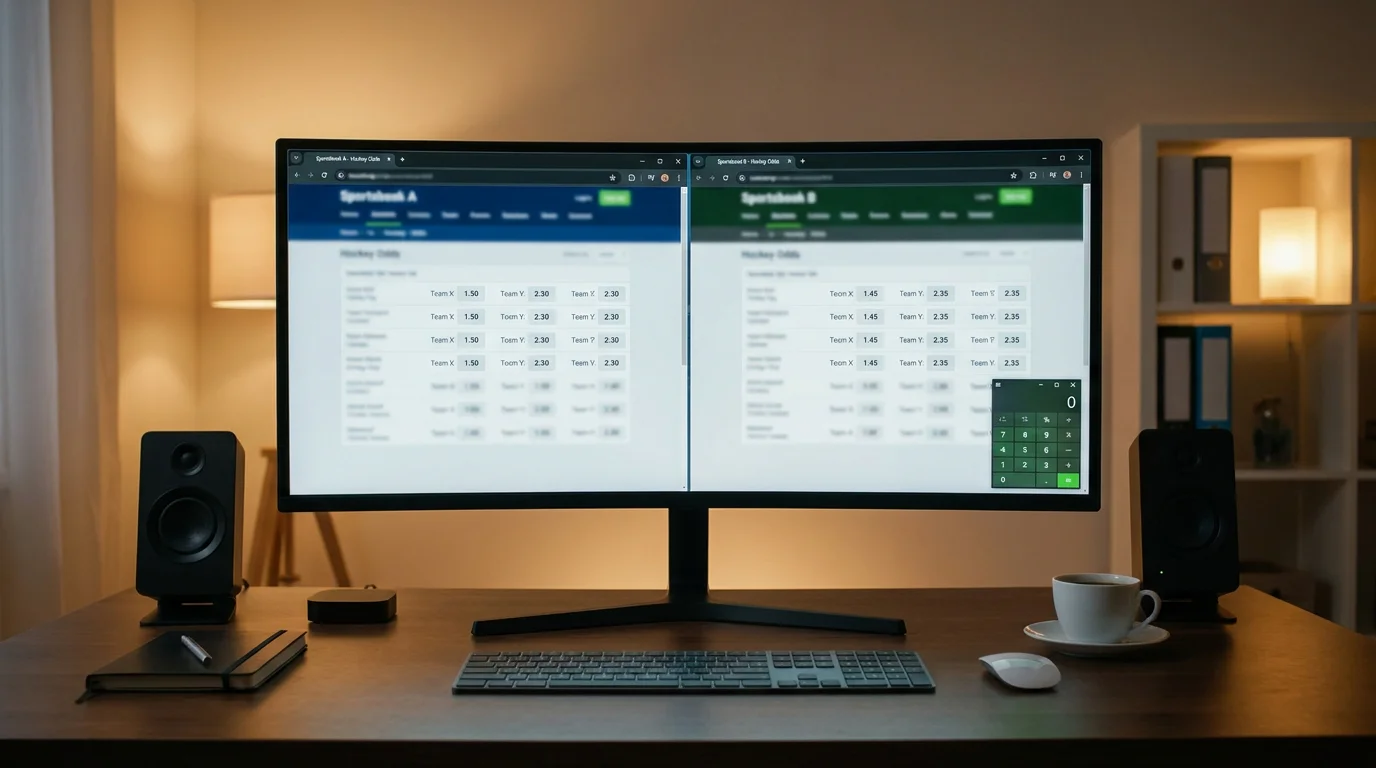
Comparing margins across operators on the same game reveals surprising differences. One bookmaker might offer a 3.5% margin on an NHL moneyline while another carries a 6% margin on the identical fixture. That gap — 2.5 percentage points — is pure cost savings if you take the tighter price. It is the single easiest improvement any bettor can make: always check at least two prices before confirming a bet.
Live Hockey Betting: Platform Speed and Coverage
I once tried to place a live bet during a power play and watched the odds refresh three times before I could confirm the slip. By the time the price stabilised, the power play was over and the opportunity had vanished. Platform speed during live hockey betting is not a nice-to-have — it is a fundamental requirement.
Hockey’s pace creates natural windows for in-play betting: period breaks, stoppages after goals, and the pause before a power play faceoff. A platform that updates odds within one to two seconds of game events lets you exploit those windows. A platform that lags by five to ten seconds effectively locks you out of the sharpest opportunities. The difference is invisible until you experience it in real time.
Live market availability varies dramatically across operators. Some UK bookmakers offer a full suite of in-play markets for NHL games: running moneyline, live totals, next goal scorer, and period-specific options that update continuously. Others restrict their live offering to a basic moneyline and totals, sometimes suspending markets entirely during fast-moving passages of play. If live betting is part of your strategy, test the experience during an actual game before committing to an operator.

Streaming integration is a related consideration. Several UK bookmakers offer live video or animated pitch trackers for NHL games within their platform. While these are not a substitute for a proper broadcast feed, they provide enough context to make informed live decisions without needing a separate screen. The combination of live odds, visual tracking, and one-click bet placement creates a genuinely useful in-play experience when the technology works smoothly.
Mobile Betting Experience for Hockey
NHL games start at midnight or later UK time. If you are betting from bed at 1 AM — which, let us be honest, most of us are — the mobile experience is your primary interface with the bookmaker. Sixty percent of sports bettors now use mobile apps as their primary betting platform, and for hockey bettors operating on UK time, that number is almost certainly higher.
A good mobile hockey betting app does three things well. It loads the hockey section quickly without forcing you to scroll through ten football leagues first. It displays odds in a clean, scannable format that lets you compare markets at a glance. And it processes bet slips without lag or unexpected price changes. These sound like low bars, but several UK bookmaker apps fail at least one of them.
Navigation matters more than you might think. On some apps, ice hockey is buried under “A-Z Sports” or “Other Sports,” requiring four or five taps to reach the NHL. Others place it on the main sports menu with a single tap to reach the day’s fixtures. When you are making a live betting decision during a 30-second stoppage, those extra taps are the difference between catching a price and missing it.

Push notifications for game events — goals, period ends, overtime — are available on most major apps and are worth enabling for any game you have action on. They keep you informed without requiring you to watch the entire game, which is particularly useful given the late-night scheduling of NHL fixtures from a UK perspective.
UKGC Licensing and Player Protection
This section is not optional reading. I have spoken with bettors who lost money at unlicensed offshore operators and had zero recourse when their withdrawals were blocked. The UKGC licence is not bureaucratic decoration — it is the legal framework that protects your deposits, guarantees fair settlement of bets, and gives you a complaints process if something goes wrong.
Every legitimate UK betting operator holds a licence issued by the UK Gambling Commission. The licence number is displayed at the bottom of their website and can be verified on the Commission’s public register. If an operator does not display a licence number, or if the number does not match the register, do not deposit. The risk is not theoretical. The Betting and Gaming Council has warned that stakes placed with illegal operators are forecast to rise from £17 billion in 2025 to more than £33 billion by 2028 — nearly one in five online betting stakes could be flowing to the unregulated market within three years if enforcement does not intensify.
UKGC-licensed operators are required to offer self-exclusion tools, deposit limits, reality checks, and cool-off periods. They must verify your identity before allowing withdrawals. They must keep customer funds segregated from operational funds. These protections exist because gambling carries real financial risk, and the regulatory framework is designed to ensure that risk is managed transparently.
For hockey bettors specifically, the UKGC licence also guarantees that odds and settlement are governed by clearly stated rules. If a dispute arises over how a bet was settled — did overtime count, was the game officially completed, was the line correct at the time of placement — a licensed operator is bound by its published terms, and you have access to an independent dispute resolution service. At an unlicensed operator, you have nothing.
I treat licensing as a binary filter. If the operator is UKGC-licensed, I evaluate their hockey product on its merits. If they are not licensed, they do not exist to me. No odds advantage or market depth advantage is worth the risk of unregulated operation.
Hockey Betting Site Questions
Bookmaker selection raises practical questions that deserve direct answers. These four cover the ground I am asked about most often.
Do all UK bookmakers offer EIHL betting markets?
No. EIHL coverage is limited to a subset of UK-licensed operators. The major bookmakers typically list EIHL match winner markets on game days, but puck lines, totals, and props are rare. If EIHL betting is a priority, check the operator’s hockey section during the domestic season before registering. You may need to hold accounts at two or three bookmakers to access consistent EIHL coverage.
Which UK sportsbook has the lowest margins on NHL moneylines?
Margins vary by game and shift throughout the day, so no single operator consistently offers the tightest price on every fixture. The most effective approach is to compare odds across two or three bookmakers before placing each bet. Over a season, this habit saves more money than any individual operator’s margin advantage. Betting exchanges also tend to offer lower effective margins on NHL markets, though liquidity can be limited.
Are there any UK bookmakers that cover KHL or SHL hockey?
Several UK-licensed operators list KHL and Swedish Hockey League markets, typically offering moneylines and totals on selected fixtures. Coverage is not as consistent as the NHL — some operators carry these leagues only for high-profile games or playoff rounds. If European league coverage matters to you, check the operator’s hockey section during the relevant season to confirm availability.
How do I verify a hockey betting site’s UKGC licence?
Scroll to the bottom of the operator’s website and look for a UK Gambling Commission licence number. Copy that number and search for it on the Gambling Commission’s public register at their official website. The register confirms the licence holder, licence type, and current status. If the number does not appear in the register or the licence status is listed as anything other than active, do not deposit funds.
