
 Available in US
Content
- The UK Has Its Own Hockey League — and You Can Bet on It
- EIHL Season Structure and Competitive Format
- EIHL Betting Markets: What's On Offer
- Which UK Bookmakers Cover EIHL
- EIHL vs NHL Betting: Key Differences for Punters
- Using Attendance and Form Data to Spot Value
- EIHL-Specific Betting Angles
- Betting on the EIHL Playoffs and Challenge Cup
- EIHL Betting Questions

The UK Has Its Own Hockey League — and You Can Bet on It
I stood in the National Ice Centre in Nottingham three years ago, watching the Panthers play the Sheffield Steelers in front of a roaring crowd, and it struck me that most UK bettors had no idea this league existed. They knew the NHL. They might have heard of the KHL. But the Elite Ice Hockey League — the UK’s own professional hockey competition — was invisible to them. That is a missed opportunity, both as entertainment and as a betting market.
Ice hockey is the number-one attended indoor professional sport in the UK and the third-largest winter spectator sport after football and rugby union. That ranking surprises people, but the attendance figures back it up. The EIHL draws real crowds, generates real passion, and — crucially for our purposes — offers real betting markets at selected UK bookmakers. The coverage is thinner than the NHL, the odds are wider, and the analytical tools are fewer. But those limitations are precisely what creates opportunity for anyone willing to put in the work.
This article covers everything you need to bet on EIHL hockey: the league’s structure, the markets available, which operators cover it, how it compares to the NHL, and the specific angles that give informed bettors an edge in a market where most punters are flying blind.
EIHL Season Structure and Competitive Format
The EIHL season runs from September through April, which overlaps almost entirely with the NHL calendar. The league currently features teams from across the UK and Northern Ireland — Sheffield, Nottingham, Belfast, Cardiff, Coventry, Dundee, Fife, Glasgow, Guildford, and Manchester among them. Each team plays a full schedule of regular-season games, with the top finishers advancing to a playoff tournament that culminates in a finals weekend.
Total attendance in the 2025-26 season reached 1,321,128 across 270 matches — an average of 3,863 fans per game. That number represents a fourth consecutive season of attendance growth. The trajectory is clear when you look at the recent history: 1,004,000 in 2022-23, 1,133,816 in 2023-24, 1,247,972 in 2024-25, and now past 1.3 million. A league that grows its audience by 30% in four seasons is not a declining product. It is a sport building momentum, and the betting markets are slowly catching up to the interest.
The competitive format rewards consistency over the regular season but leaves room for chaos in the playoffs. Regular-season standings determine seeding, home-ice advantage, and which teams advance. But the playoff format — short series or single-elimination rounds depending on the stage — compresses variance and produces genuine upsets. A team that finishes fifth can beat the regular-season champion over a two-game aggregate, and it happens often enough to make the playoffs a distinct betting environment from the regular season.
The Challenge Cup adds another layer. This knockout competition runs concurrently with the regular season and features two-legged ties decided on aggregate score. It creates scheduling pressure — teams deep in both the league and the Cup play more games per week — and produces meaningful fixtures even in the early months of the season when regular-season stakes are relatively low.
For bettors, the key structural insight is that the EIHL is a two-phase sport. The regular season rewards the deepest, most consistent rosters. The playoffs reward goaltending, momentum, and home-ice crowd energy. Your analytical approach needs to shift between phases, and the bookmakers do not always adjust their pricing quickly enough to reflect the transition.

EIHL Betting Markets: What’s On Offer
When I placed my first EIHL bet, the only market available was a straight match winner. No totals. No puck line. No period markets. Just “who wins” and a pair of decimal odds. Three seasons later, the situation has improved — but it is still a long way from the 80-market buffet you get on an NHL game.
The core EIHL market at most UK bookmakers is the match winner, which includes overtime and any shootout. Some operators also offer a three-way market (regulation time only, with a draw option), but this is less common. The match winner is your primary tool for EIHL betting, and for many games it may be your only tool.
Totals markets — over/under on the combined goals — appear at selected operators on EIHL game days, usually with a line of 5.5 or 6.5 goals. EIHL games tend to be higher-scoring than NHL games on average, partly because goaltending depth is shallower and partly because the pace of play produces more transition chances. When a totals market is available, it often presents better analytical opportunities than the match winner because you can model scoring based on recent team data without needing to predict the winner.
Puck line markets on EIHL games are rare. When they do appear, the standard 1.5-goal spread applies the same way as in the NHL, but the odds may be less precisely calibrated because the bookmaker has less data and less volume to inform the pricing. Treat EIHL puck lines with caution — the wider margins often embedded in these lines reduce the effective value even when you have a strong opinion on the outcome.
Player props, period betting, and in-play markets are almost nonexistent for EIHL at UK bookmakers as of 2026. The infrastructure is not there yet. This may change as attendance continues to grow and bookmaker interest follows, but for now, EIHL betting is fundamentally a match-winner and occasionally a totals proposition.
The limited market range is not necessarily a disadvantage. It forces you to focus on the fundamentals — which team is more likely to win, and is the price fair? — rather than spreading your analysis thin across dozens of secondary markets. Some of my most profitable bets have been simple EIHL match winners where I had a clear view on the game and the bookmaker’s price was generous.

Which UK Bookmakers Cover EIHL
Not every UK bookmaker lists the EIHL, and the ones that do vary in their consistency. Some operators carry EIHL markets every game day throughout the season. Others list only high-profile fixtures — playoff games, rivalry matchups, or games involving clubs with the largest fanbases.
Sheffield Steelers, who drew an average of 8,122 fans per game in 2025-26 including a league-record 9,512 on Boxing Day, are the most reliably listed team across UK bookmakers. Their audience size generates enough betting interest to justify consistent coverage. Belfast Giants, Cardiff Devils, and Nottingham Panthers also appear frequently because of their larger fanbases and arena capacities. Smaller-market teams — Fife Flyers, Dundee Stars, Glasgow Clan — may appear only on weekends or when they face a more prominent opponent.
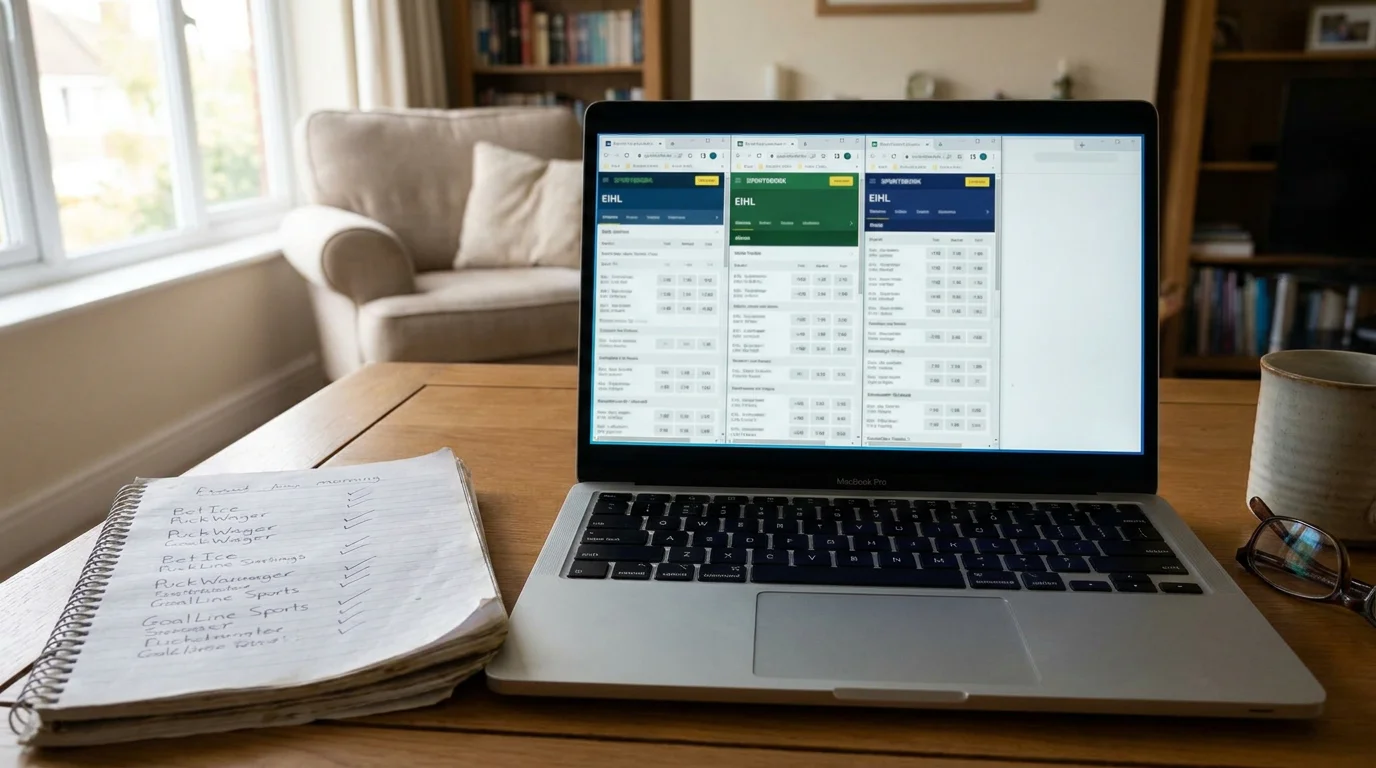
The inconsistency creates a practical challenge: you cannot always plan your EIHL betting in advance because you do not know which games will have markets until the operator publishes them, typically on the morning of a game day or occasionally the evening before. I check my bookmaker accounts every Saturday morning during the EIHL season, because weekends are when the widest selection of EIHL markets tends to appear.
If you are serious about EIHL betting, hold accounts at three or four UKGC-licensed operators that have shown a pattern of covering the league. Compare which ones list EIHL on a given game night, and bet at the one offering the best price. This is the same odds-shopping principle that applies to the NHL, but it matters even more for EIHL because the margins tend to be wider and the price differences between operators can be significant.
One trend worth watching: as EIHL attendance grows and the league’s commercial profile rises, bookmaker coverage is expanding. Two operators that did not list the EIHL at all in 2023 now carry it regularly. If the attendance trajectory continues, market depth should follow — which means more opportunities for bettors who have already built their analytical foundation in the league.
EIHL vs NHL Betting: Key Differences for Punters
The NHL is projected to generate between $7.5 billion and $8 billion in revenue for the 2025-26 season. The EIHL operates on a fraction of that — a fraction so small that the two leagues occupy fundamentally different universes in terms of data availability, media coverage, and betting infrastructure. Understanding those differences is essential before you start wagering on both.
Data is the biggest gap. The NHL produces an enormous volume of publicly available statistics: advanced metrics like expected goals, Corsi, Fenwick, and high-danger chance percentages are tracked for every game and available for free. The EIHL has basic stats — goals, assists, penalty minutes, team standings — but nothing approaching the analytical depth of the NHL. You cannot build the same kind of statistical models for EIHL that you can for the NHL, which means your edge in EIHL betting comes from different sources: watching games, tracking roster moves, understanding team dynamics, and building your own informal database over time.
Scheduling is another key difference. NHL teams play 82 regular-season games. EIHL teams play fewer, and their schedules include midweek and weekend clusters that can produce fatigue effects similar to NHL back-to-backs but with less public visibility. An EIHL team playing their third game in five days may not have that context reflected in the bookmaker’s odds, because fewer people are tracking the EIHL schedule closely enough to factor it in.
Roster volatility is higher in the EIHL. Import player rules limit the number of non-British trained players each team can carry, and these import slots are frequently shuffled mid-season. A team that loses a key import forward in December and replaces him with an unknown in January can see its competitive profile change dramatically — and the bookmaker’s pricing may lag behind the reality.
The timing advantage works differently too. NHL games start late in the UK evening, forcing you to stay up or place pre-game bets and check results in the morning. EIHL games are played at UK-friendly times — Saturday and Sunday evenings, Wednesday nights — meaning you can watch live, assess the flow, and potentially take advantage of in-play opportunities at the rare operators that offer them.
Using Attendance and Form Data to Spot Value
Mark Brooks, the EIHL’s Head of Commercial Operations, described the 2025-26 season as a significant milestone — a fourth consecutive attendance record, with over 1.3 million fans through the turnstiles and outstanding atmosphere across the league. Those are not just feel-good numbers. For bettors, attendance data is a practical analytical tool in a league where advanced statistics are scarce.
Attendance correlates with home-ice advantage in the EIHL more strongly than in the NHL. The reason is arena capacity and crowd density. When Sheffield Steelers play in front of 8,000-plus fans in a packed arena, the noise and energy create a tangible home-ice effect. When a smaller-market team plays in front of 1,500 in a larger venue, the atmosphere is flat. I have found — through tracking my own bets over three seasons — that EIHL home teams in venues consistently filled above 80% capacity outperform the odds at a rate that exceeds random variance.
Form data in the EIHL requires more manual effort than in the NHL, but it is available. League standings, recent results, and basic scoring stats are published on the official EIHL website and updated after each round of fixtures. The analytical edge comes from tracking form trends that the bookmaker’s pricing model may not capture: a team that has won four straight after a coaching change, a roster that just added a strong import player, or a club that consistently performs poorly on Sunday afternoons after Saturday night away trips.
The combination of attendance patterns and recent form is a powerful filter for EIHL betting. A team playing at home in a packed arena, coming off three consecutive wins, facing a travel-weary opponent on the second night of a weekend double-header — that confluence of factors regularly produces mispriced odds. The bookmaker prices the game based on overall season records and generic home-ice percentages. You price it based on the specific context of that fixture. The gap between those two assessments is where value lives.

I keep a simple spreadsheet with three columns for each EIHL team: last five results, next opponent’s schedule context, and the home attendance trend. It takes ten minutes per week to update, and it has been the single most useful tool in my EIHL betting approach.
EIHL-Specific Betting Angles
Every league has its quirks, and the EIHL’s quirks create betting angles that simply do not exist in the NHL. The import player rule is the most significant. Each team is limited in the number of non-British trained players it can roster, and these imports typically represent the top talent on each squad. When a key import is injured, suspended, or traded mid-season, the team’s competitive level drops sharply — often more sharply than the bookmaker’s odds adjustment reflects.
Tracking import player availability is the closest thing the EIHL has to the NHL’s goaltender-confirmation edge. I follow team social media accounts and local sports press for each EIHL club, because import player news often breaks there before it reaches the bookmaker’s radar. A Saturday morning announcement that a team’s leading scorer is out with an upper-body injury can make the pre-game odds instantly generous for the opposition. The window of value is short — sometimes only a few hours — but it is real and recurring.
Weekend scheduling creates another angle. Most EIHL teams play a Saturday-Sunday double-header, often with travel between venues. The Sunday game is the EIHL’s equivalent of the NHL’s back-to-back, and the effects are even more pronounced because EIHL rosters are smaller and have less depth to absorb fatigue. I give a meaningful probability bump to home teams in Sunday fixtures when the opponent played away on Saturday night and had to travel. The bookmaker’s model rarely accounts for this with sufficient granularity.
The attendance growth I described earlier is not a betting angle in itself, but it creates a tailwind. Growing crowds mean growing public interest, which means growing betting volume, which means bookmakers will invest more in pricing the EIHL accurately over time. For now, the market is still catching up, and the information asymmetry favours anyone who watches games and tracks the league closely. Enjoy that edge while it lasts — it will narrow as the sport continues to build momentum.

Rivalry matchups deserve special attention. Belfast against Cardiff, Sheffield against Nottingham, Glasgow against Fife — these fixtures draw larger crowds, generate more intensity, and produce results that deviate from season-long form. Underdogs perform better in rivalry games because motivation levels equalise. I apply a small adjustment to my probability estimates for derby fixtures, nudging the underdog’s chances upward by two to three percentage points.
Betting on the EIHL Playoffs and Challenge Cup
The EIHL playoffs are compressed chaos. A league that played 270 regular-season games condenses its postseason into a few weeks of elimination rounds, culminating in a finals weekend where the remaining teams play at a neutral venue. The format varies slightly from season to season, but the consistent feature is that regular-season dominance does not guarantee playoff success. I have watched the league’s best regular-season team exit in the first round more than once.
Playoff hockey in the EIHL amplifies every factor I have discussed. Goaltending becomes more dominant because the stakes eliminate casual effort. Home-ice advantage intensifies because the crowds are louder and more invested. Fatigue matters more because games come in rapid succession. And the bookmaker’s pricing — based primarily on regular-season records — struggles to account for the psychological and tactical shifts that define elimination hockey.
The Challenge Cup operates on a knockout format with two-legged ties decided on aggregate score. This creates a fascinating betting dynamic: the first leg is a scouting exercise as much as a competitive fixture, and the second leg — with aggregate context — produces different tactical behaviour. A team that leads by two goals on aggregate will play conservatively. A team trailing by one will push hard early. Those tactical adjustments affect scoring patterns and create opportunities in totals markets when they are available.
My approach to EIHL playoff and cup betting is more conservative than my regular-season approach. The sample sizes are tiny, the variance is enormous, and the stakes per game are higher in terms of emotional intensity. I reduce my bet sizing by about 30% during the postseason and focus exclusively on spots where I have a strong contextual opinion — typically home teams in front of large crowds facing fatigued or depleted opponents. The rest of the playoff card, I watch for entertainment rather than profit.

EIHL Betting Questions
EIHL betting generates specific questions that do not apply to the NHL. These four address the practical realities of wagering on UK domestic hockey.
Are EIHL betting markets available in-play?
In-play EIHL markets are extremely rare at UK bookmakers. A small number of operators occasionally offer a live match winner during high-profile games, but consistent in-play coverage with running totals and period markets does not exist for the EIHL as of 2026. If live betting is a core part of your strategy, you will need to focus on the NHL for now and treat EIHL as a pre-game market.
Why are EIHL odds harder to find than NHL odds at UK bookmakers?
The EIHL generates significantly less betting volume than the NHL, which means bookmakers earn less revenue from pricing it. The data infrastructure for EIHL is also less developed, making it more expensive for operators to build accurate pricing models. As attendance and public interest grow, bookmaker coverage is expanding, but the EIHL remains a niche product at most UK sportsbooks.
Can I bet on EIHL individual player performance?
Player prop markets for the EIHL are essentially unavailable at UK bookmakers. The NHL offers goalscorer, shots on goal, and assists props at most operators, but the EIHL does not have sufficient data feeds or betting volume to support individual player markets. Your EIHL betting options are limited to match winners and occasional totals.
How does EIHL’s import player rule affect team strength for betting?
Each EIHL team is limited in the number of non-British trained players it can roster, and these imports are typically the most skilled players on the squad. When a key import is unavailable due to injury, suspension, or a mid-season trade, the team’s competitive level drops noticeably. Tracking import player availability through team social media and local press gives you an information advantage that the bookmaker’s odds may not reflect until after the game starts.
