
 Available in US
Content

The Puck Line Is Hockey’s Answer to the Point Spread
I spent my first two years betting hockey exclusively on moneylines. Every single wager was a straight pick-the-winner proposition, and I did not even glance at the puck line column. That changed one February night when I backed a heavy favourite at 1.28 decimal odds and watched them win by three goals. The return was pitiful relative to the risk, and a friend pointed out I could have laid -1.5 on the same team at 1.90. That conversation rewired how I think about hockey spreads.

The puck line is the NHL’s fixed spread, almost always set at 1.5 goals. If you back a favourite at -1.5, they need to win by two or more goals for your bet to land. If you take an underdog at +1.5, they can lose by a single goal and you still collect. It sounds simple, but the implications run deep once you consider that underdogs covered the puck line at roughly 60% during the 2024-25 NHL season. That number alone tells you the standard spread sits in a zone where underdogs have a structural edge on paper, and understanding why is the entire point of this article.
How the ±1.5 Puck Line Works
Three seasons ago, I remember explaining the puck line to a rugby-mad colleague who kept comparing it to a handicap. He was right in principle but wrong in one critical detail: unlike football or rugby handicaps that float up and down, the standard puck line in hockey is almost always nailed at 1.5 goals. The bookmaker adjusts the odds on each side of that line rather than moving the spread itself. This single quirk changes everything about how value appears in the market.
Here is the mechanic stripped to its bones. Take a game where Team A is a clear favourite and Team B is the underdog. The puck line offers two options. Back Team A at -1.5, and they must win by at least two goals. Back Team B at +1.5, and they can lose by one or win outright for the bet to settle in your favour. The 1.5-goal gap means a one-goal game always splits the result: the favourite loses the puck line, the underdog covers.
Odds on the puck line tend to mirror the moneyline in reverse. When a favourite is priced short on the moneyline, their -1.5 puck line will often sit around even money or slightly above. When the moneyline favourite is only marginally shorter, the -1.5 price inflates because a two-goal winning margin becomes less certain. I track these relationships in a spreadsheet, and the correlation is tighter than most people assume.
One detail that catches beginners: puck line bets in the NHL typically include overtime and shootouts for settlement purposes. If your team is +1.5 and they lose in a shootout, the final score is recorded as a one-goal loss, which means the +1.5 still covers. This is a meaningful edge that affects how you assess close games between evenly matched sides.

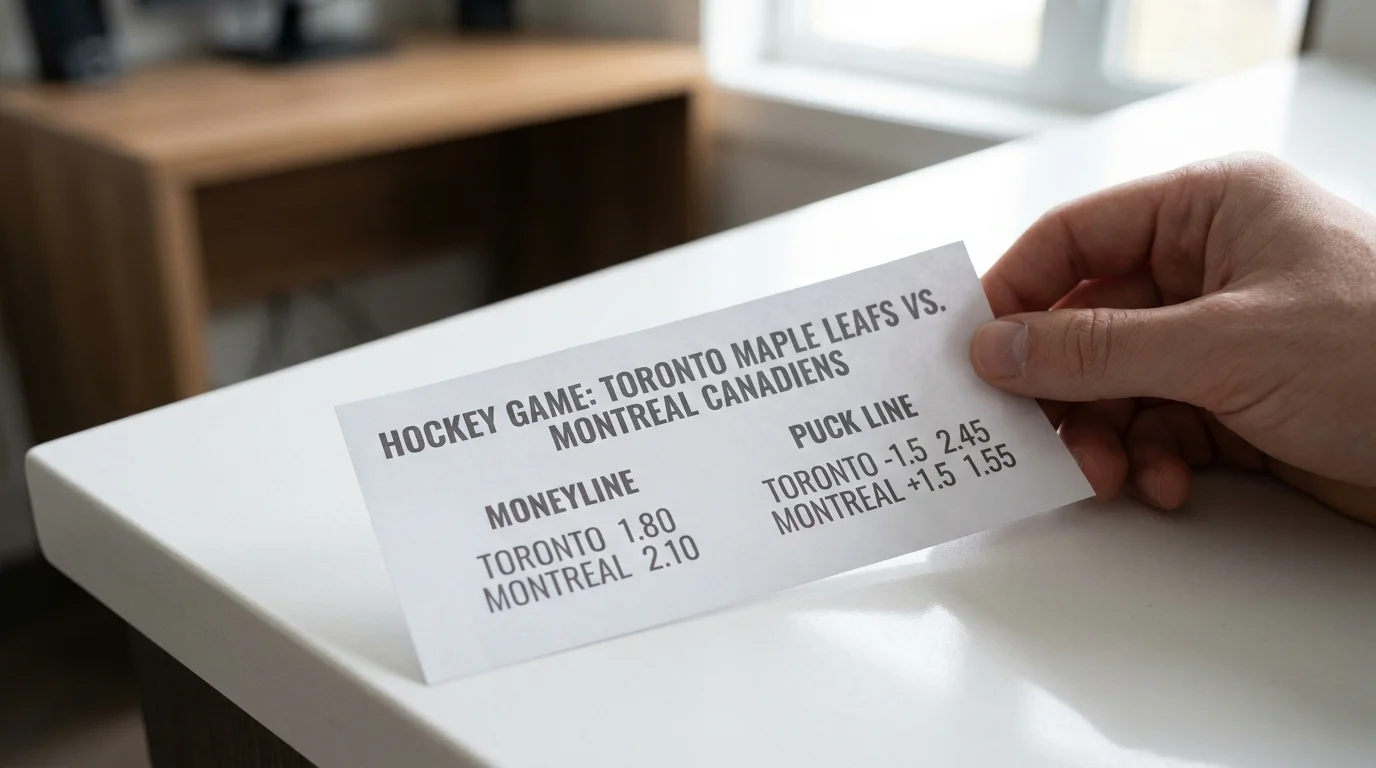
Consider a concrete example. Suppose the Edmonton Oilers are hosting the Calgary Flames. The moneyline prices Edmonton at 1.55 and Calgary at 2.50. The puck line might show Edmonton -1.5 at 2.30 and Calgary +1.5 at 1.62. If you believe Edmonton wins comfortably, the -1.5 at 2.30 gives you far better value than the 1.55 moneyline. But “comfortably” is doing a lot of work in that sentence — you need a two-goal margin, not just a win.

When Puck Line Bets Offer Better Value Than the Moneyline
I keep a running log of every puck line bet I have placed since the 2021-22 season. One pattern screams off the page: puck line underdogs in games with lopsided moneyline pricing deliver consistent long-term returns. The logic is almost mechanical. When a favourite is priced at 1.30 or shorter on the moneyline, the implied probability sits above 75%. But NHL underdogs win outright 39.1% of the time across a full season, and they cover the +1.5 spread at that roughly 60% clip. The gap between the implied probability and the actual cover rate creates a value pocket.
Think of it this way. The moneyline on a heavy underdog might sit at 3.40 — the bookmaker is pricing in about a 29% chance of winning outright. The +1.5 puck line on the same underdog might land at 1.62, implying roughly 62%. If the real cover rate hovers around 60%, the market is pricing that +1.5 almost perfectly. Not much edge there. But on specific subsets — home underdogs, back-to-back situations for the favourite, backup goaltender starts — the cover rate climbs above 60%, and that is where the puck line becomes the sharper tool.

Favourites on the -1.5 side can also offer value, but you need to be selective. Teams with dominant five-on-five goal differentials and strong special teams units win by two or more goals at higher rates than the market often prices. I look for situations where the favourite’s moneyline is between 1.40 and 1.60 and the -1.5 puck line is above 2.10. That range tends to produce the best risk-reward ratio because the market underestimates blowout potential in games that look closer on the surface.
The key comparison is always puck line versus moneyline. If you are backing a favourite, the moneyline gives you a higher hit rate but lower returns per unit risked. The puck line gives you worse hit rates but meaningfully better prices. For underdogs, the +1.5 puck line is essentially insurance against a close loss, and the price you pay for that insurance is the difference between the moneyline and puck line odds.
Alternative Puck Lines: ±0.5, ±2.5, and Beyond
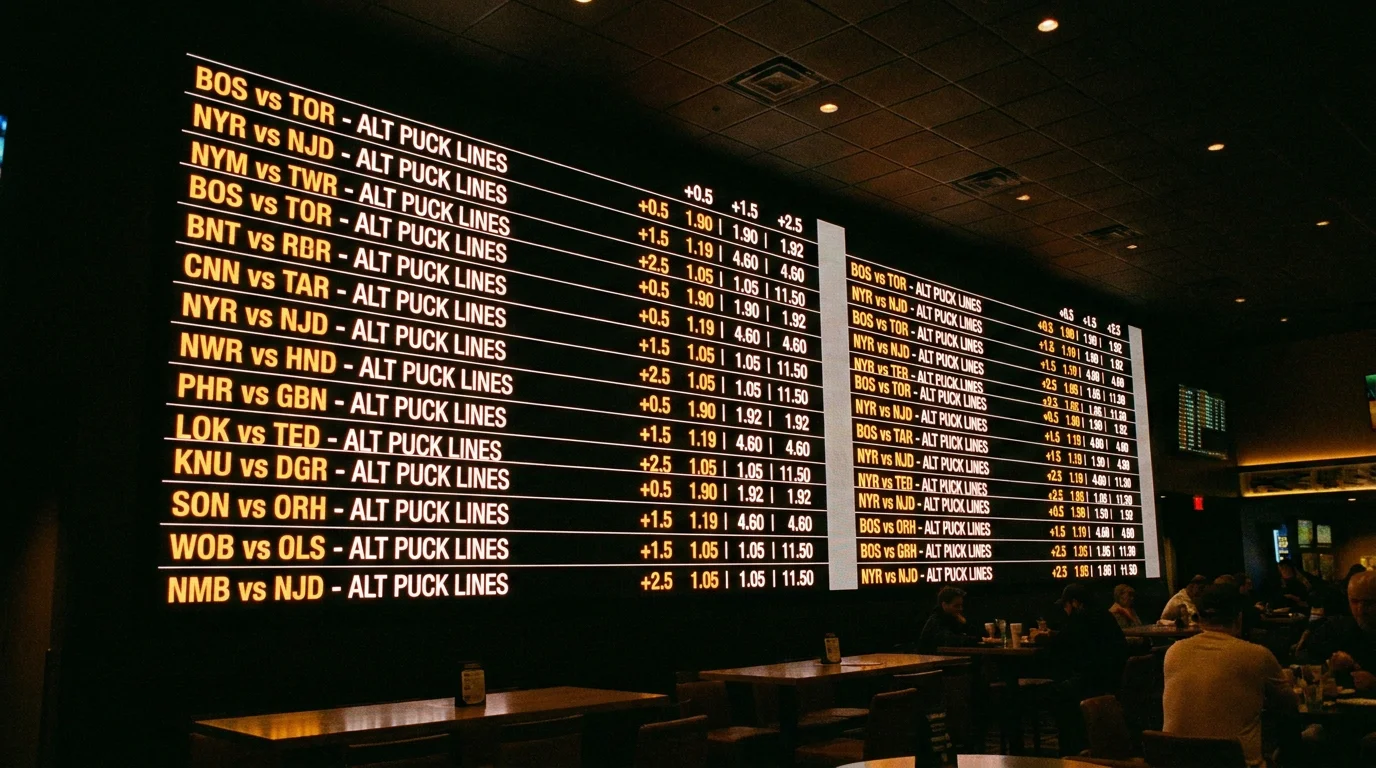
Last season I experimented almost exclusively with alternative puck lines for a six-week stretch, and the exercise taught me more about line pricing than any textbook. Most major bookmakers now offer alternate spreads beyond the standard 1.5. You will see -0.5, +0.5, -2.5, +2.5, and occasionally -3.5 or +3.5. Each step changes the odds dramatically because hockey is a low-scoring sport where a single goal reshapes everything.
The -0.5 puck line is functionally identical to the moneyline — a team at -0.5 just needs to win by any margin. Bookmakers sometimes list it as an alternative line at a slightly different price than the standard moneyline, so it is worth checking for marginal odds differences. The +0.5 is the mirror: your team can draw or win. In the NHL regular season there are no draws, so +0.5 is only relevant if the bet settles on regulation time only.
The -2.5 spread is where things get interesting for backing favourites in games you expect to be one-sided. The price jumps significantly — a favourite who is 2.30 at -1.5 might be 3.80 or higher at -2.5. But in certain playoff matchups or when an elite team faces a backup goaltender on the road, the -2.5 can represent outstanding value. I have found that looking at teams with a Corsi-for percentage above 54% at five-on-five improves hit rates on the -2.5 line noticeably.
On the other side, the +2.5 for underdogs drops the odds to something like 1.20 to 1.30 — low juice, low risk, but useful in accumulators where you need a safe leg. Just be aware that bookmaker margins on alternative lines tend to be wider than on the standard 1.5, so the price you see already has more built-in edge for the house.
Puck Line Questions
What happens to a puck line bet if the game goes to overtime?
In most cases, NHL puck line bets include overtime and shootouts. If your team is +1.5 and loses in a shootout, the final score is recorded as a one-goal loss, so the +1.5 covers. Always confirm settlement rules with your specific bookmaker, as regulation-time-only puck lines exist as a separate market.
Is the puck line always set at 1.5 goals in the NHL?
The standard puck line is 1.5 goals for virtually every NHL game. Unlike point spreads in football or basketball, the number rarely changes. Instead, bookmakers adjust the odds on each side of the 1.5-goal line. Alternative puck lines at 0.5, 2.5, or 3.5 goals are available at most major sportsbooks as separate markets.
